
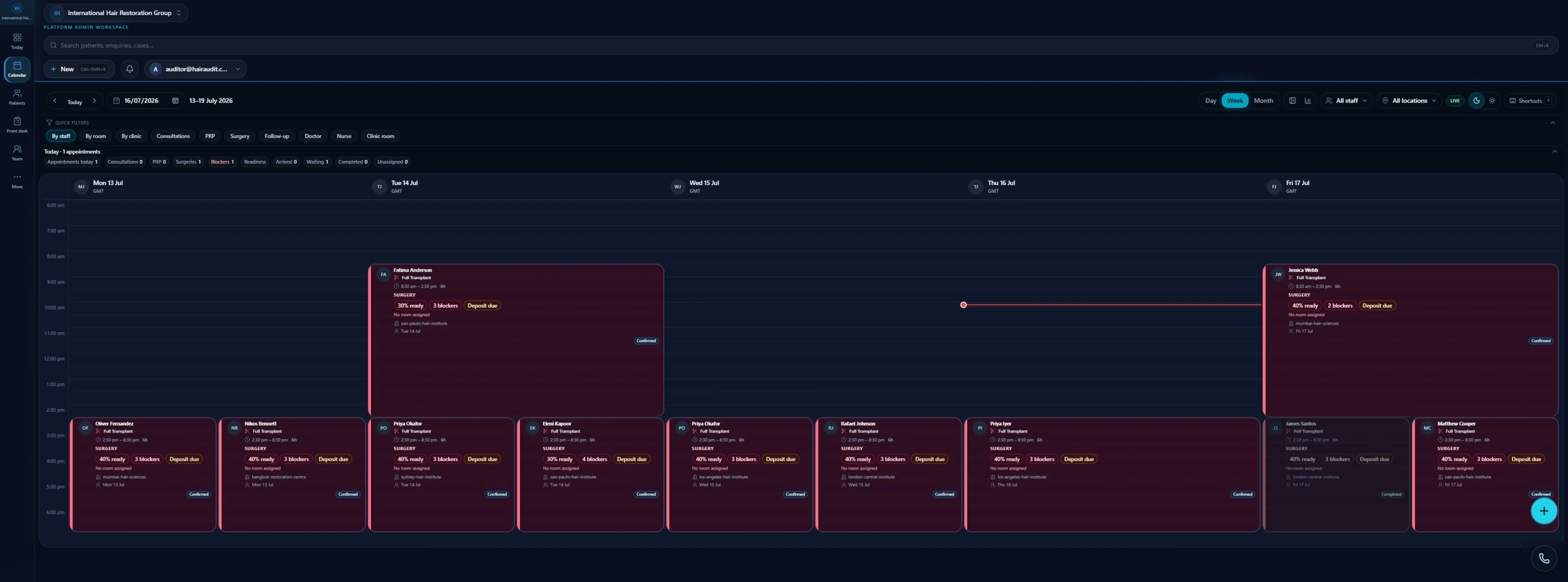
CalendarOS
Coordinate consultations, treatments, teams and surgery.
Hair restoration operating system
We Built One Specifically For You
Most clinics operate across disconnected software never designed for hair restoration medicine.
Follicle Intelligence connects consultations, surgery, patient intelligence, staff training, outcomes, analytics, and clinical operations into one purpose-built operating system — with progressive adoption so day-to-day clinic work is protected.
See Connected Platform SystemsView Platform Progress
23
Systems Tracked On Platform Progress
15
Deployed Or Operational Pilot
Operational Pilot Underway
Built Exclusively For Hair Restoration Medicine
Operational reality
01
02
03
04
05
06
Operational inefficiency directly impacts clinic profitability
Small inefficiencies compound across every consultation, procedure and patient journey.
Connected infrastructure
8 core clinic systems highlighted below — a curated subset of 23 systems in the public progress registry (15 deployed or in operational pilot). Full delivery status by module is on Platform Progress.
Patient surface
The connected patient surface for next steps, milestones, documents and journey participation.
The clinic manages the journey in FI. The patient follows and completes it through the app.
PatientOS remains the clinic-facing longitudinal record. The FI Patient App is the patient-facing continuation of that journey.
Explore FI Patient AppStrategic architecture
Architecture map (12 intelligence layers) for the hair restoration operating system — complementary to the 23 systems tracked with honest delivery status on Platform Progress. Acquisition, consultation, clinical intelligence, imaging, trichoscopy, surgery, workforce, operations, finance, outcomes, education, deployment, and executive analytics in one connected ecosystem.
Follicle Intelligence Ecosystem Architecture
Category distinction
Horizontal software
Clinical intelligence platform
Generic Software Helps Run Clinics
Follicle Intelligence Helps Clinics Perform Better
Progressive adoption
Clinics can connect their existing systems, transition in controlled stages, or progressively move their operations into Follicle Intelligence.
Connect, transition or replace — at a pace that protects clinic continuity.
If your clinic uses HubSpot today, the same pathway applies: connect, coexist, transition selected history in verified stages, or replace when you are ready.
Selected data or workflows continue to operate with your current systems connected to FI.
FI and your existing tools operate alongside one another during a controlled adoption period.
Selected contacts, workflows and history move into FI through verified stages.
FI becomes the primary operating environment within the agreed deployment scope.
Product proof
From enquiries and scheduling to surgery, workforce and outcomes, FI brings the clinic's essential workflows into one connected operating environment.
CalendarOS
Coordinate consultations, treatments, teams and surgery.
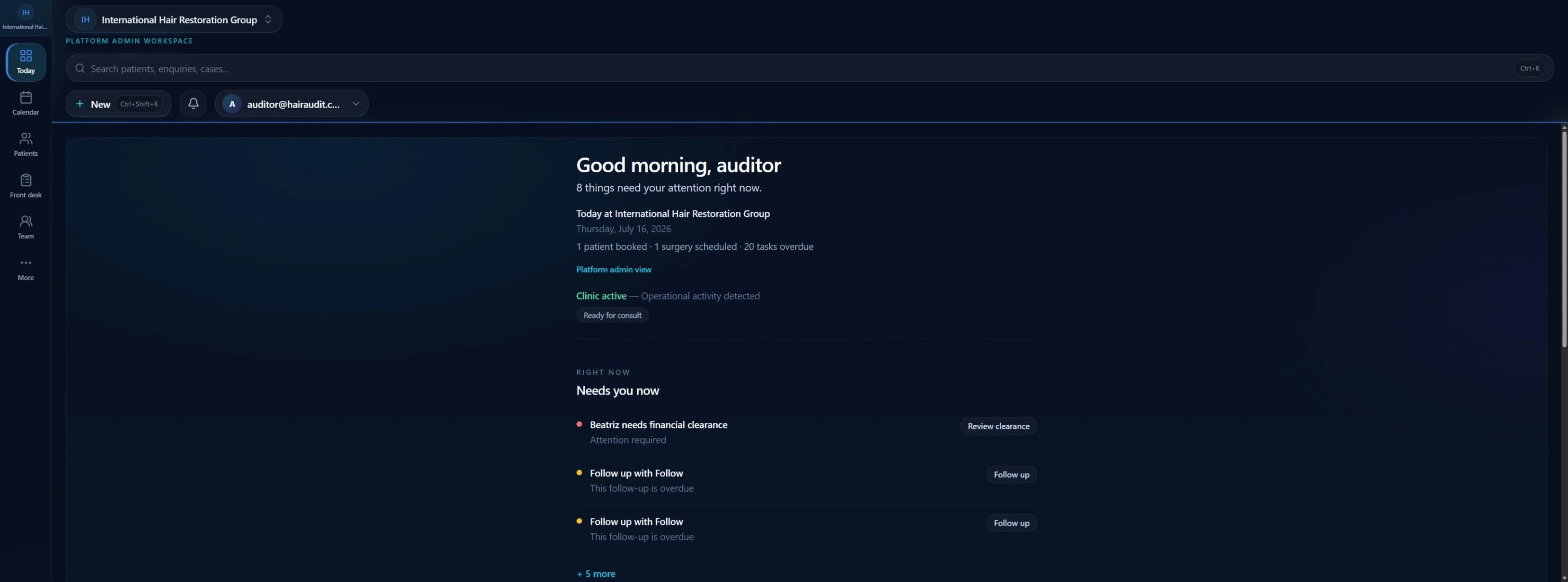
Today
See what needs attention across the clinic.
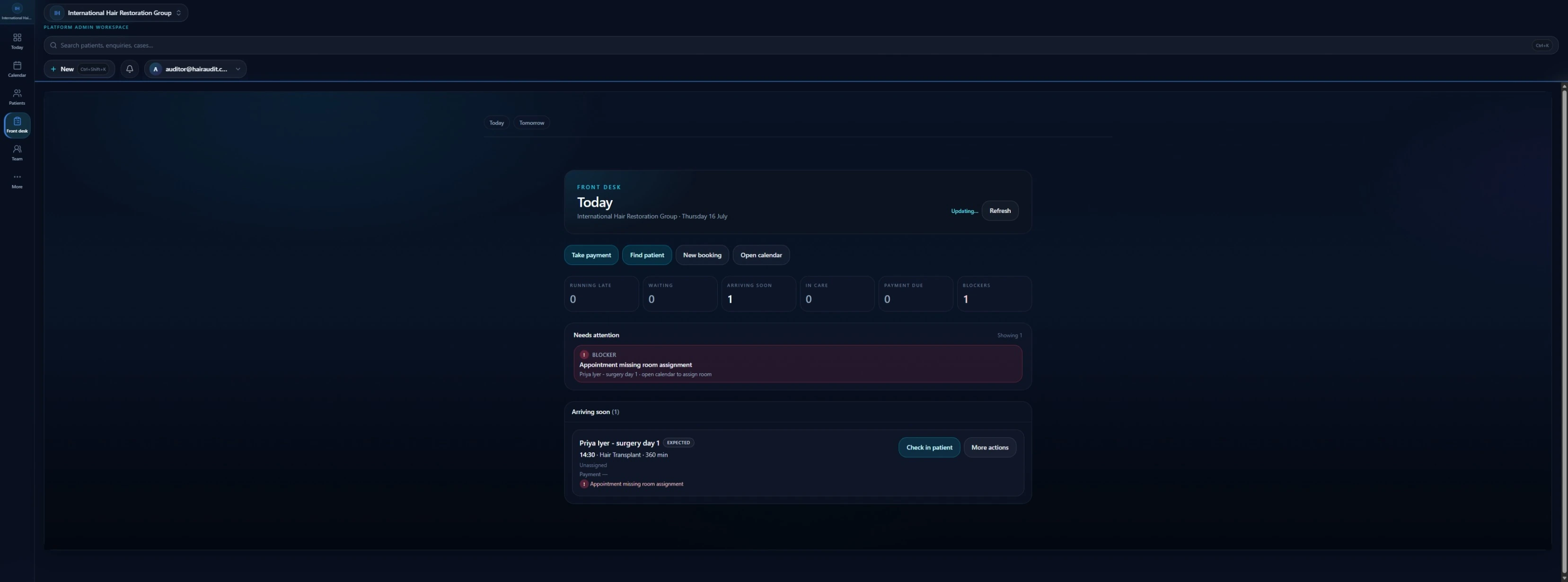
Front Desk
Manage arrivals, delays, blockers and patient flow.
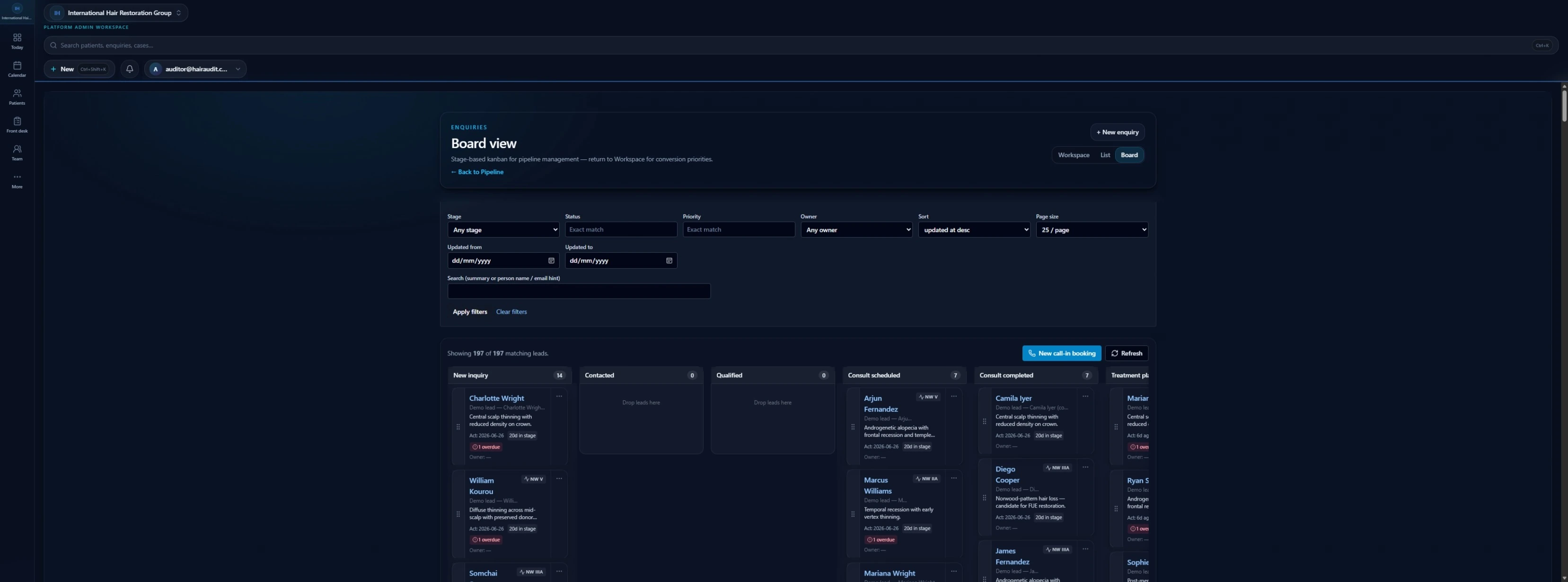
LeadFlow
Manage ownership, follow-up and conversion.
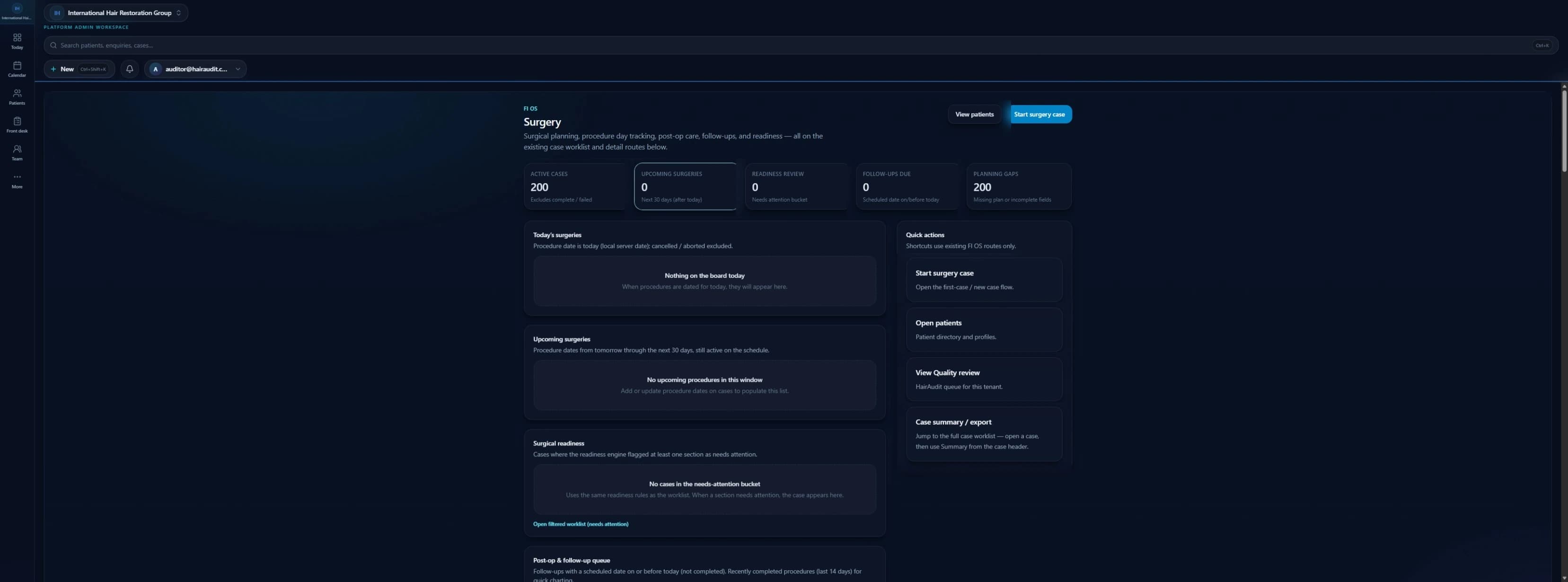
SurgeryOS
Coordinate planning, readiness, procedures and follow-up.
Interface shown with demonstration data.
Surgical intelligence
Clinics can objectively measure procedural quality at the level where outcomes are actually created.
Every extraction.
Every graft.
Every team member.
Every surgical variable.
Measured continuously.
01
Grafts extracted
02
Hair per graft ratio
03
Punch size selection
04
Extraction speed
05
Transection rate
06
Implantation speed
07
Donor preservation score
08
Recipient density planning
09
Medication protocols
10
Assistant performance comparison
11
Team efficiency scoring
12
Procedure benchmarking
Every Procedure Becomes Measurable
Outcome intelligence
Most clinics perform procedures every day without truly understanding which variables produce better long-term patient outcomes.
01
12 month growth scoring
02
Density progression
03
Donor recovery monitoring
04
Hairline design scoring
05
Patient satisfaction tracking
06
Surgeon performance benchmarking
07
Technique comparison analysis
The Clinics That Measure Outcomes Improve Faster Than The Clinics That Guess
Workforce intelligence
High-performing clinics depend on high-performing teams. But most clinics have no objective system measuring workforce readiness, competency progression or procedural preparedness.
01
Training assignments
02
Certification management
03
Clinical readiness scoring
04
SOP completion
05
Competency verification
06
Role-based permissions
07
Compliance monitoring
Better Teams Create Better Procedures
Industry credibility
Designed around actual procedure-day operational demands
Built around actual patient conversion pathways used in clinics
Created around surgeons, nurses, consultants and technicians
Operational pilot underway for scoped modules — unfinished capability is not presented as fully deployed
This platform was not adapted for hair restoration clinics. It was built from inside them.
The future
The most successful clinics in the future will not simply attract more patients.
They will understand their operations better.
They will measure procedures more precisely.
They will train better teams.
They will improve outcomes more consistently.
And they will continuously learn from every patient interaction.
Better systems create better clinics. Better clinics create better outcomes.
Enterprise infrastructure
This is infrastructure for an entire medical industry.
See how twelve intelligence layers connect acquisition, clinical decision support, surgical execution, workforce competency, and long-term outcomes into one operating system built exclusively for hair restoration medicine — adopted progressively, with 23 systems tracked and delivery status you can review on Platform Progress.